|
THE BEGINNING OF MY SPITFIRE
ERA
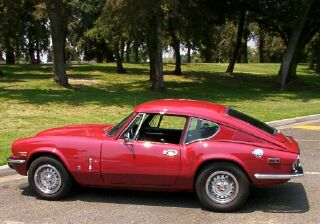
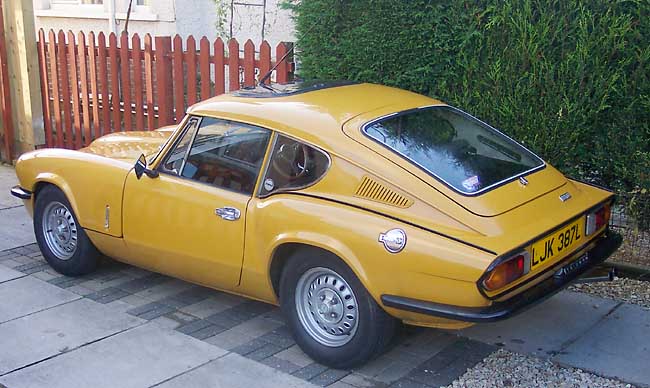
I bought my first Spitfire when I as
18 years old, that was in 1982. I had no idea what
a Spitfire even liked like. I happened to be
reviewing the local newspaper's classified car ad
section looking for a used car and a friend
happened to see a Spitfire listed. He mentioned
that a Spitfire was small but sporty looking
English car. He talked me into looking at the car.
After seeing the car, a 1974 Spitfire, I
immediately fell in love with it. I negotiated the
asking price of $1,800 to $1,000. I had brought the
full $1,800 with me but before arriving I tucked
$800 inside my shoe. The owner did not know this so
I able to buy the car for $1,000. The 'old wave the
cash in front of his face method' usually works.
Shortly afterwards, this same friend told me about
the AC Cobra and how the bodylines were similar to
the Spitfire. I started conducting some research on
the AC Cobra and was able to find some articles
with pictures and specifications of the car. I
agreed with my friend's opinion about having
similar body styling to a Spitfire.
Within the next two years I had either bought,
sold, accumulated, parted out, etc. approximately
six other Spitfires. This had become a sort of
hobby or side job where I was actually making a
little money. I acquired my seventh Spitfire from
Clarkies Salvage yard in Saratoga Springs, New York
under a theft recovery title. Before buying the car
at the salvage yard I fired up the 1500cc engine.
There was a loud knocking noise and I thought the
lower unit was bad. One of the salvage yard's
employees told me it was only a loud value tick. I
thought it was little excessive for a value problem
but at this time I had no experience with lower end
problems. I bought the car for $800 dollars.
Latter, when I got home and pulled the head off and
realized I had a fist size hole in the block. The
hole was in an area that you could not easily see
or access from the top of the engine. I think they
knew this at the salvage yard but live and learn
and trust your instincts. After finding out that
the engine was wasted, I decided I would use the
car to make a replica of an AC Cobra on Community
College student's budget, which was not much to say
the least. Today I have an excellent relationship
Clarkies Salvage Yard but I still give them grief
about that car. They have more than made up for
that mistake over the past 18 years by providing me
with numerous parts and favors that has made my V-6
conversions possible.
PAST HISTORY USING THE 2.6L CAPRI
V6
In 1984, I started transplanting a
2.6 L V-6 from a 1972 Capri into my Spitfire. At
this time I was 20 years old with no automotive
design or engineering experience. I decided to use
the 2.6L V-6 based on its dimensions and reputation
as a decent high RPM engine, at least for a small
V-6. Some basic modifications were made to the car
to get the engine to fit. Since the 2.6 L V-6 was a
60-degree engine it was rather tall (see picture 1)
compared to original Spitfire 1.5 L and the current
4.3 L V-6 90-degree engine. In order to accommodate
the height of the intake and carb a hole was needed
in the bonnet. My crude custom design engine mounts
probably did not help much in terms of the height
clearance problem. Initially I used the Capri 4
speed manual transmission and the original Spitfire
rearend. A new driveshaft was fabricated by a local
machine shop that obviously did not know what they
were doing, nor did I in that case. The machine
shop welds looked like my first arc welding welds,
which resembled pigeon droppings.
Afterwards I had a radiator shop make some
modifications to the Spitfire radiator so I could
use it with the 2.6 L V-6. After I figured out how
to hook-up the clutch and transmission linkage then
I could at least start and move the car. So my
friend, Aaron Pulaski, and I fired the beast up
with only the exhaust manifolds installed. The
monster started and I could move it under its own
power but it was loud as hell and was shooting
flames out the exhaust manifolds like a
fire-breathing dragon. With no further improvements
or time the next day, my friend and I took the car
to the New York State Department of Motor Vehicles'
(DMV) theft recovery unit in Albany, New York for
an inspection. The car had to be inspected before
DMV would issue new VIN tags since the car was
theft recovery vehicle. No one at DMV told me
before hand that the vehicle had to be driven into
the garage on its own power. Neither the car, nor I
was prepared for this little problem. The car had
no interior or battery. The clutch cable, like most
of the other components, was not properly fastened
in place. If the car were not driven in under its
own power, I would have had to forfeit the $100
inspection fee. At this time, this was about a week
of wages for me. So we took the battery out of our
tow vehicle and installed in it the Spitfire. With
no exhaust system or seats, we fired the beast up
again. It was difficult to control the gas and
clutch especially without having a seat. Like a bat
out hell, tires spinning and loud as dirt track
car, I drove into the garage. This certainly was
not intentional. I had never driven the car before
and I was using a wash bucket as a seat. You should
have seen the expressions on the inspectors' face.
Shaking their heads they just looked at me like I
was crazy. Afterwards the inspectors openly shared
their thoughts with me. They said "your going to
kill yourself in this thing". I am not sure if it
was my design or the concept that really concerned
them. Boy being young was fun!
Once the car was finished and painted in 73
Corvette yellow driving it at 55mph your teeth
would fall out because the car shaked so much
because of an unbalanced driveshaft. Believe it or
not, a friend who is a sheriff clocked me in this
beauty at 105 mph on radar. Still, looking back 15
years, the project was a success for the most part,
but certainly it was not a work of art. Sometimes I
don't know how I managed to create it or dared to
drive it.
MAJOR PROBLEMS AND
MODIFICATIONS
The major problems plaguing the car
were rearend blowouts, over heating, and a poor
exhaust system. Every year I would blow out one or
two of the stock Spitfire rearends. The Spitfire
half-shafts were also a problem especially the
flanges since they would either split or the bolts
would always loosen up even after using locktite.
Finally after blowing out the Capri 4-speed
transmission I decided to put a Ford C-4 automatic
transmission in the car to reduce the shock being
delivered to the Spitfire rearend. This was
somewhat of a major project since the Spitfire
frame needed to be modified. After having the frame
modified by a professional shop with racecar
experience, the transmission was coupled up to a
new drive shaft that had been properly fabricated
by Universal Joint in Syracuse, New York. Still
even after using the C-4 automatic we had another
rearend blowout. After thinking about it and doing
some research we decided to replace the Spitfire
rearend with a Datsun 610 rearend which is very
similar to the Datsun 240-60Z cars rearends. By
this time I had been introduced to someone, Tom
Roock, who could rebuilt, design, and fabricate
anything so it looked and functioned better than
any OEM equipment. Fortunately for me he became
interested in the project and from that point on we
have been "partners in crime".
To fit the new
Datsun rearend, we had to remove the original
Spitfire frame from the rear seats back and
fabricate a new one. The Spitfire
tub had
to be modified with spring and frame pockets to
accommodate the new frame and rearend. The
fabrication and installation of the Datsun rearend
spanned 9 months and took about 2,000 man-hours to
complete. We used 3" x 5" box steel to fabricate
the new frame. We tapered the frame tails and made
other modifications that are functional but also
look good. We still used the Koni shocks in the new
rear suspension system. The rearend and frame
modifications are truly a piece of art that
function much better than the OEM system. The only
portion that we had to "farm out" was the
shortening of the half shafts
since they were made of hardened steel.
After driving the car for several years, we
realized the rearend was no longer a weak point in
terms of both durability and handling. As you
probably know, if you take a Spitfire hard into a
sharp corner, the rear suspension geometry does not
give you much in terms of real handling. The tires
want to tuck in under the car causing it to roll
and over-steer in really hard cornering situations.
By using a shortened Ford 9-inch straight axle
rearend, we would have greatly reduced the number
hours on this phase of the project. However, the
Ford rearend would not provide the handling and
traction that the truly independent Datsun 610
rearend gives us.
MOVING TO THE 4.3L V6
After working the rearend bugs out,
I decided I wanted more performance from the Capri
V-6. We had already modified the engine with a
four-barrel intake, Holley 4BBL Carburetor, custom
cam, and solid timing gears. Custom headers would
be the next logical step. After Tom and I realized
that no matter what we did within reason and
budget, we would still have only 158 cubic inches
to work with. So we carefully researched engines,
their weight, dimensions, oil pump location, parts
availability, and of course took into account the
engine's cubic inches. We did not want to modify
the bonnet or the firewall. Except for the side
pipes, we wanted to keep the car looking stock from
the outside. After many debates and discussions,
the general consensus was to use the Chevy 4.3L
V-6. The engine had a good track record, parts were
available and reasonably priced because many of the
small block parts can be used on the Chevy 4.3L
V-6.
Backing our
engine choice was the fact that the Chevy 4.3L V-6
has quite the punch even when in a relatively heavy
Sports Utility Vehicle with an automatic
transmission and emissions equipment. To fit test
the Chevy 4.3L V-6 we borrowed an engine core from
my friend's salvage yard (Central Auto Recycling).
From the fit test we knew the engine swap was
feasible with some modifications. So the next thing
I did was to buy a low mileage engine (30K) that we
would leave stock, so we thought. To physically fit
the Chevy 4.3L we had to make custom motor mounts
and modify the oil pan so we could lower the engine
further. Now it sits just above the steering
rack. We used engine-mounting system that
bolted to the front of the engine. The headers, of
course, were custom made with about 150 man-hour.
By looking at them, you would think they were made
at the factory and they sounded like it too. They
use a cross over pipe that is tucked neatly under
the frame and exits into a set of side pipes.
Some modifications to the floor pan on the
passenger side were necessary to clear the frame
rails and to accommodate the Borg & Warner T-5
transmission. The frame needed to be slightly
notched to access the oil filter for easy removal
and installation. We had also decided to swap tubs
since I had bought another car that had a tub in
better condition. So we had to remake the rear
suspension modifications on the new tub. The stock
sheet metal from the new tub was MIG-welded into
the old tub so I could use it on a stock frame.
At the time, that was the plan, but things
change in life. Shortly afterwards, I decided to
apply to law school. I was accepted and off I went.
For one year I hardly touched the car. I
sandblasted the front cowl section and replaced the
floor pan and the inner and outer rockers on the
driver's side. Everything was mig-welded
watertight. The welds were ground down evenly on
the floor pan so everything looked OEM. The car
spent the next year in a garage and the following
year outside as four other projects occupied my
spare time so I could earn some spending money. I
ended up buying a 1967 Jaguar XKE 2+2, 1973 TR-6,
1980 TR-8, 1976 MGB, (3) 1980 Spitfires, a 1978
Spitfire, and a London Taxicab before getting
started again on the V-6 Spitfire Project. I did
some mechanical work to get the Jag running and
then sold it. The real problem was I got into a
full restoration on the TR-6 that took about 2
years. I bought the car for $800 and sold it for
$9,500 to an avid Triumph owner. This gives you an
idea how well the restoration was done. I repainted
it the original OEM dark brown, almost black, which
would show any imperfections. I wish I still had
that beauty. I restored another stock Spitfire and
MGB before really starting again on the Chevy 4.3L
V-6 Spitfire. The remaining cars I bought were
parted out or needed only minor repairs before I
sold them.
THE CHEVY V6 ENGINE
The point the V-6 Spitfire was
neglected for several years. During its storage
outside, the tarp had weathered and ripped,
allowing water to leak down through the intake into
the engine. The entire oil pan was full of water.
So after graduating from law school, completing a
masters degree, and successfully passing the bar
exam, it was time to finally start the project
again. By this time, I was working in a Upstate New
York law firm as an attorney so time, to say the
least, was especially limited since I practiced
International Law and had to travel to Asia
frequently. When I was off on business in Asia, I
had the engine completely rebuilt by a local
machine shop. We could have done it ourselves and
put it back together as a slightly modified engine,
but since time was short, I sent it to the machine
shop. We had the block bored out, installed a
custom ground cam, forged pistons, ARP rod bolts, a
roller timing chain, new valves, roller rockers,
heavy duty valve springs, an Edelbrock manifold, a
Holley 4 barrel carburetor and other high
performance components so the engine would be solid
up to 6,500 RPM and could take a nitrous boost at a
later date. To keep everything under the original
Spitfire bonnet, the Edelbrock manifold had to
planed down. We decided at first point to go with a
carbureted system. We wanted to make the throttle
cables match the yellow color scheme or the car.
Instead of using the all to common black throttle
cable I found some matching bright yellow bicycle
cable at a local bicycle shop. A Holley electronic
fuel pump that is mounted in the trunk compartment
feeds the fuel system. In the near future we may
look at using Fuel Injection and/or Nitrous. The
distributor is out of a 229 V-6. We also dressed
the engine up with a few chromed accessories and
aluminum valve covers.
THE TUB/SHEET METAL
The next problem that needed to be
addressed was the tub that we had already taken the
time to install new suspension pockets and modify
the floor pans since it had become badly rusted as
a result of the water leaking through the tarp. It
was still a workable tub, but I managed to locate
another Spitfire that had been stored inside a
factory in Albany, New York for about ten years.
The car was originally from Alabama. I had found my
new donor tub. I recovered most of the cost of the
donor car by selling the Spitfire's 1.5L engine and
transmission. The tub was basically rust free but
had some hidden bondo in it that was not noticed
until we stripped it. This project was a complete
frame off restoration. Every component, and I mean
every thing, was stripped from the tub and frame to
be replaced or rebuilt and then painted. Once
everything was stripped from the frame I had it
sandblasted. The frame was then primed it with PPG
DP-42 etching epoxy primer and then painted with
black PPG DCC urethane single-stage paint.
As for the tub, we debated on whether to have it
acid dipped or lightly sandblasted. The tub was
basically rust free and the closest acid dipping
facility was 10 hours away so we decided to have it
sand blasted. I took the tub and doors to be sand
blasted by the same person who had done the frame.
He had done a decent job on the frame and he
assured me he could do the sheet metal without a
problem. He mentioned that he had done a number of
sheet metal pieces and only once warped one. Tom
and I told him to be extremely careful since we had
put countless hours into locating the tub and
straightening and modifying the sheet metal. We did
not want any warpage. He assured us it would not be
a problem and that it would be finished the next
day. I was the first to arrive to inspect the job.
I almost cried! Most people would not have noticed
the panels were warped. However, I had done enough
bodywork to notice it immediately. It was difficult
to see because of the peaned surface of the
sandblasted metal. Next, I ran my hand across the
panels and I could not believe what I felt.
I did not say much until Tom showed up. He did
not think that it was warped badly until we got the
sheet metal home. Before I left, I told the
sandblaster I would have to think about how I
wanted to solve the problem. He did not know I was
an attorney. When we got home we realized he had
warped every panel on the car, including the floor
pans and the metal dash. Later, I called the
sandblaster about the warpage problem and he
admitted that he used too much air pressure. I
later sued him for $2,800, the judge awarded me
$1,600. It took us another week to re-straighten
the sheet metal and another 300 hours on the
bodywork. Earlier in the project, Tom and I had
made a rotisserie from two engine stands that
made working on the tub easier. Once the
bodywork was finished, it was off to my friend's
body shop (Franklin Restorations) to be painted. We
used a total of 4 gallons of PPG epoxy DCC single
stage '73 Corvette Yellow on the inside and outside
of the car.
COOLING SYSTEM
After fit testing about 20 different
radiator models, we found an aluminum one from a
Chevy Corsica that would work for our application.
The single motor, dual speed cooling fan is from a
Ford Taurus with 3.0L engine. We used two Honda
thermostat switches to control the fan. One switch
is installed in the intake manifold and the other
one is installed inline between the radiator and
intake manifold. An inline adapter was needed to
couple the thermostat housing hose to the radiator
hose since the hose diameters were not the same.
The petcock treads on the inline adapter were the
same as the Honda thermostat switches. Sometimes
you get lucky! The thermostatic controls are run
through two heavy duty Ford Taurus fuel pump relays
that are actuated by the thermostatic switches. The
power draw from the fan is substantial, so using
the relays reduces the load on the fuses.
By having one temperature switch on the manifold
and other one inline, they kick-in the dual speed
fans at different temperatures. The temperature
switch and radiator work like a charm. Even on the
hottest days sitting in traffic the temperature
does not move above 190 degrees. The frame had to
be slightly notched to accommodate the
Chevy
Corsica radiator. We made a custom aluminum
radiator shroud and support. This took about 100
hours. If you look at the radiator, you would not
know what is keeping it in place. It looks better
than a stock application (see picture 6)
BONNET SUPPORTS
To keep the Spitfire bonnet up, we
used modern hydraulic hood props to replace the
cheap, ugly and poorly working original Spitfire
bonnet prop. We used two, one on each side. Now,
the hood can be opened effortlessly by one person.
It also looks nice. Obviously we had to design
mounts for the new props. The bonnet prop mounts,
on the frame side, were made from aluminum while
the mounts on the bonnet side were a combination of
aluminum and steel.
CLUTHCH AND TRANSMISSION
Fitting the new Borg-Warner T-5
transmission in the car was fairly easy since the
modifications to frame that were previously done to
fit the C-4 Ford transmission were sufficient. We
removed the Spitfire rear transmission mount and
made a new one that accepts a GM rear rubber
transmission mount. Of course we had a new drive
shaft made.
Figuring out the mechanics to operate the clutch
was another matter. I wanted to use the original
Spitfire hydraulics and to try and keep things
relatively simple and easy to replace. The only
problem was the Chevy small-block manual
transmission's bell housing was set up to push the
clutch fork from the front side of the engine. This
meant the slave cylinder would need to be mounted
on the engine side of the bell housing. We did not
have enough room between the transmission and bell
housing for the clutch fork so we could not use
this setup. Fortunately for us the bell housing's
clutch fork pivot ball boss was a tapped hole which
if enlarged would accept the Triumph's slave
cylinder on the backside.
Still we had to change the pivot of the clutch
fork from a front to back setup. Luckily the Ford
Mustang along with other vehicles also use the T-5
with a slightly different setup. The Ford Mustang
uses a clutch fork that pivots on the opposite
side. This I thought would give us the motion we
wanted to push the clutch fork from the back of
transmission towards the engine, basically the same
as a Spitfire. The Ford Mustang clutch fork also
accommodated the GM throwout bearing. We had to
make another mounting boss for the pivot ball. This
had to be TIG welded, ground, sanded, drilled and
tapped. The clutch fork also had to be cut and
reinforced. Other portions of the bellhousing were
also modified to reinforce the mounting of the
slave cylinder. We also made a cover for the slave
cylinder to keep it clean and dry. We had tried
using the more common Spitfire slave cylinder with
a 7/8 inch bore, but the throw was not long enough.
We needed a smaller bore for more throw. Lucky for
us, the early Spitfires used a 5/8 bore that worked
perfectly. This was after spending about 20 hours
looking and trying several other different slave
cylinders. The total hours spent modifying the bell
housing was about 100 hours. The clutch and
pressure plate are from a Chevy V-8 Camaro.
Hooking the speedometer up took some more
thought and calculations. We wanted to be able to
use as many stock parts as possible so we hooked a
54" MGB speedometer cable to a 90-degree adapter to
give us the necessary clearance between the frame
and transmission. The 90-degree adapters are used
on the Spitfire overdrive transmission and most
MGBs. The threads on the Borg & Warner T-5
transmission speedometer unit needed to machined
from a standard thread to a machine thread like the
one used on the 90-degree converters. The inside of
the GM speedometer gear drive coupler needed to be
hand filed out to properly fit the MGB cable. After
checking the speedometer gear and finding out the
speedometer was not accurate, I calculated things
out using a relational formula to determine the
right speedometer gear. It worked and now the
speedometer is dead on. We verified this by using a
Global Positioning Satellite unit.
BRAKES AND SUSPENSION
To increasing braking efficiency, we
used the GT-6 suspension and braking components.
The rotors and the disc brake calipers are more
heavy duty than the Spitfire's. The front pads are
about 30% bigger than the Spitfires are. Braking
now is not an issue. We used rear drum brakes from
the Datsun 610. They are about twice the size of
the original Spitfire brakes. The tires are BF
Goodrich TA Radials, on the rear I use 245/60 14"
while the front are 185/70 13". Both the front and
rear tires are mounted on the older style magnesium
slot mags.
ELECTRICAL SYSTEM
An AC Delco 94 amp alternator powers
the electrical system of the Spitfire. I installed
a used GM fusebox that has 20 fused circuits as
compared to the Spitfire's three. Now all the
Spitfire's electrical components are separately
fused. We also moved the fuse box into the interior
of the car up under the dash. It is easy to access
using a pivoting bracket we made. So when not in
use, it is tucked under the dash. When needed, it
conveniently swings down for easy access. The GM
fuse box also has a heavy-duty circuit breaker
built into it that we decided to use for the
headlights. The headlights, of course, are Halogen.
The battery was moved to the trunk for weight
and appearance reasons. The battery was installed
in a sealed plastic marine battery box that is
secured by a custom-built battery mount. The
positive battery cable runs through the wheel
arches and the interior of the rocker panels. This
keeps the cable out of harms way and the elements.
The original Spitfire battery box was welded
closed. The firewall section was completely
refinished with about 200 hours of labor.
INTERIOR TOUCHES
I
rebuilt all the Smith instrumentation gauges. I
also decided to add Smith oil and amp gauges, and a
VDO vacuum gauge. I made a new dash from solid
Honduras mahogany to match the wooden LeCarra
steering wheel. Before making the new dash, we
decided to relocate the head light and hazard
switches. I used MG directional indicators since
the MG used two green arrows indicating left and
right rather than the one round green light on the
Spitfire that merely tells you the switch is on.
Now you know which directional is on plus the MG
arrows look much classier. The electronic
tachometer and speedometer are out of a 1968 MGC
that came with a factory 6-cylinder engine. The
gauges are smaller in diameter than the original
Spitfire's and look better. Also the MGC tachometer
is labeled for a 6-cylinder engine. The tachometer
still needs to be rewired so it can be used with
the HEI ignition system. The stereo system consists
of a Blauplunk AM/FM cassette player, a Blauplunk
10 Compact Disc Player, a Jensen 100 amp amplifier
and Jensen Speakers.
THE FINISHED PRODUCT
When we first fired up the beast she
ran a smooth and quiet as can be with just a little
tweaking. As for horsepower the engine is putting
out about 265 HP. I don't need to say how quick the
car is, do I? But I will just the same. The quarter
mile drag strip time with street tires 14 seconds.
I figure we should be in low thirteen's with race
slicks based on my 60 foot times, and high twelve's
with some tweaking on the engine. As for a torque
rating we estimate it to be about 260 ft/lbs@2900
RPM. 0-60 MPH estimated at 5.0 seconds with a top
speed of 142 MPH. Lets put it this way when I race
at the strip I start in third gear and can still
smoke the tires.
As for street and highway driving the car drives
like a dream. Cruising at 70mph in 5th gear the
engine is only turning about 1,800-2,000 RPM. I
have had up it to 120mph on the NY thruway without
any shakes or effort from the engine. I figure that
we have about 5-8,000 hours into this project. If
you saw the car or had the pleasure to drive it you
would know it.
WHAT'S NEXT
Now, I live and work in China. The
car is stored in a garage in Syracuse, New York
basically year round. Once a year, in the summer, I
return to New York for about one month to drive the
car. I think giving up my Spitfire is one of the
biggest sacrifices I made coming to China. I had
just completed the project before leaving for China
in 1998. Since completing the project I have only
driven the car for 1,200 miles but every second I
am in it there is a big smile on my face. As some
of you know my next project is having leather seat
covers made for the car here in China.
CREDITS AND THANKS
Lastly and most importantly I would
like to thank the following people for their help:
Tom Roock, like a big brother, the best mentor
anybody could have, and on making the project
possible and nearly perfect.
Aaron Pulaski and Clovis "Cobber" Carey for
their assistance with the Capri 2.6L V-6 conversion
and continued support and advise.
Joe Simon at Central Auto Recycling, Syracuse,
NY (315) 468-3454 for their help and supplying me
with the parts to figure out how to put the beast
together. Without them I would have been lost and
even poorer.
Jeff Franklin of Franklin Restorations in
Syracuse, NY, (315) 478-1103, for teaching me the
right way to do restoration quality bodywork and
letting me use his shop to finish my bodywork.
Walt Clark of Clarkies Salvage Yard in Saratoga
Springs, NY for giving me access to some of his
most prized English car parts. If you call him, he
will probably tell you he does not have any English
car parts, he saves them for me.
My good friend Mark Driscoll who probably did
more talking than work but never the less was there
when I needed him and his advise.
Return to Swaps Index
|