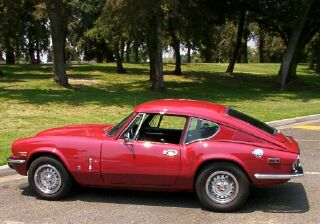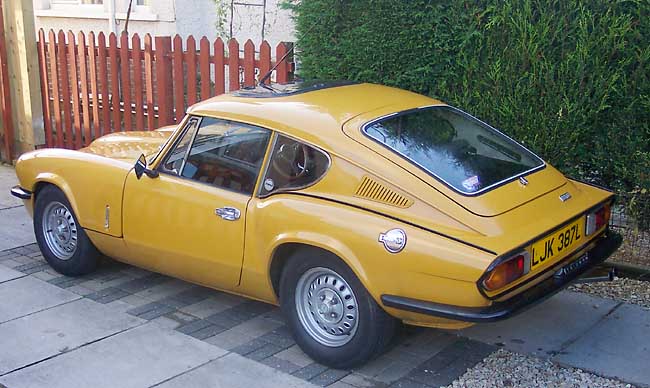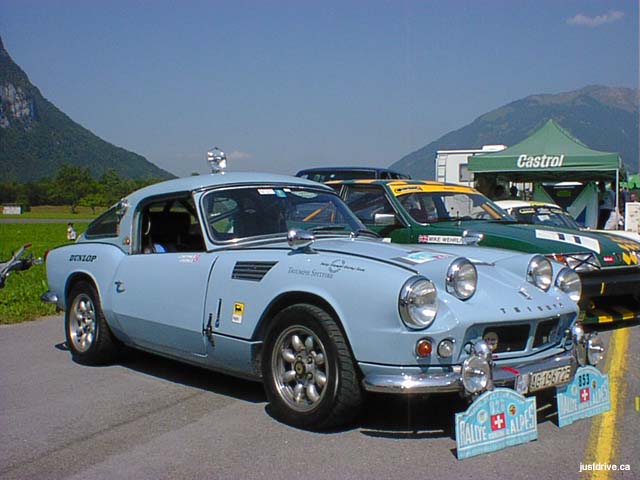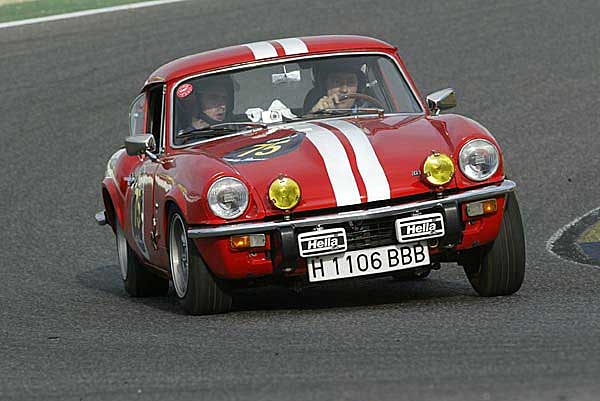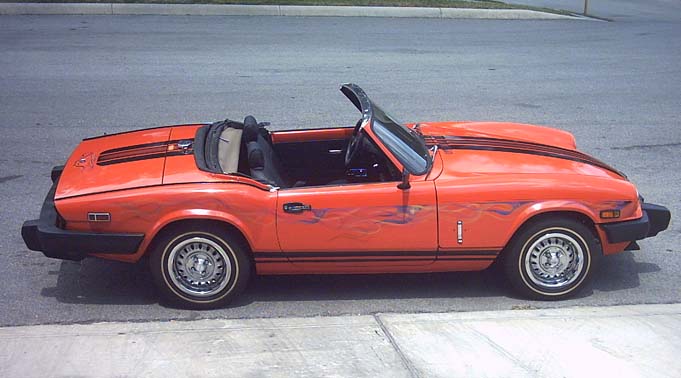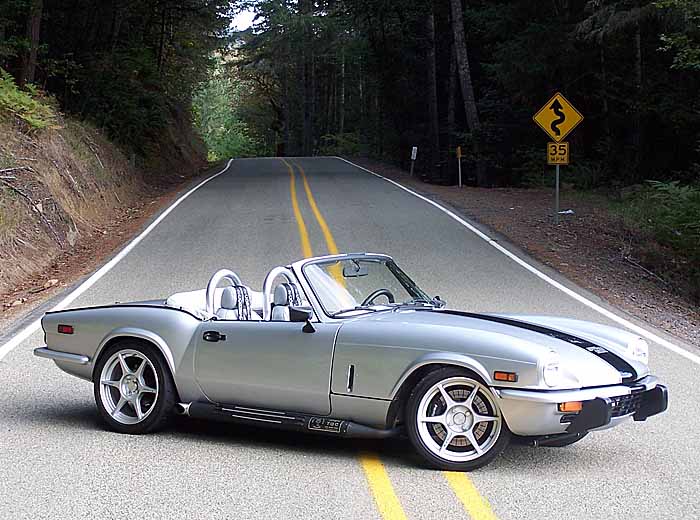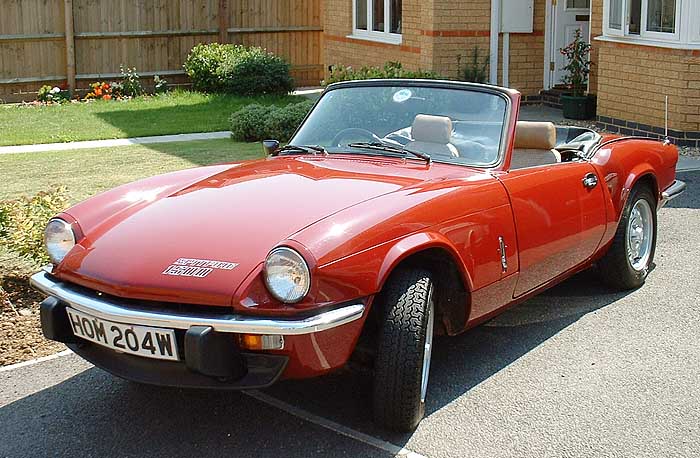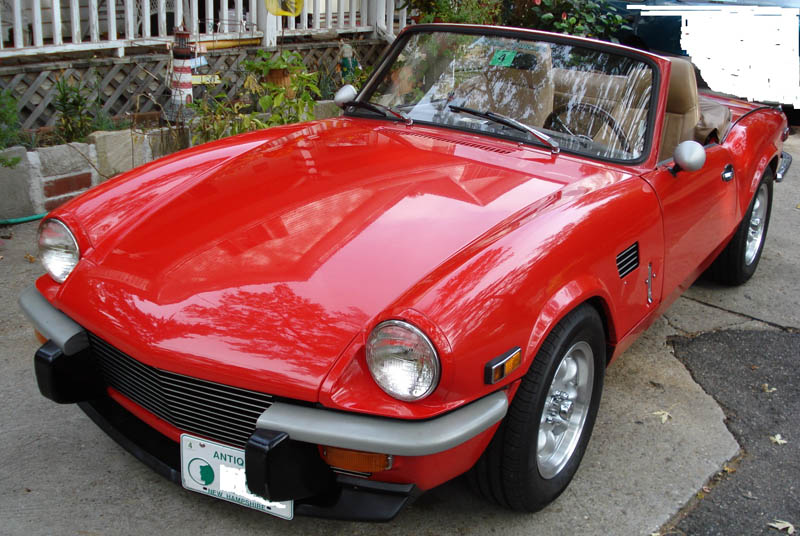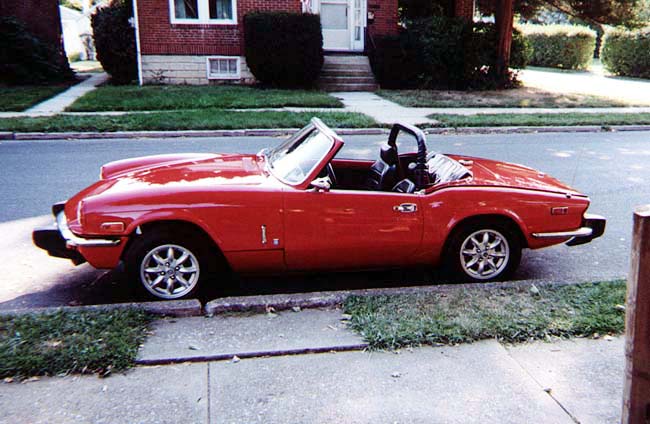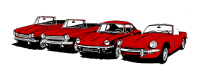
I originally purchased this car, a
1972 Signal red Spitfire, in 1973 with just over
5000 miles on the odometer. After several
breakdowns and just general lack of horsepower,
remember the 72 was rated a whopping 48 BHP, I'd
just had enough. I was in the local wrecking yard
and saw a 2.6 liter Ford Capri and thought, I bet I
could stuff that in my Spitfire. That was some 22
years and many iterations ago, and this is the car
in it's current, ever evolving state.
The current engine, a 1974 Ford
2.8 liter V6, which I entirely rebuilt and had
balanced, is equipped with a mild street cam (Comp
cams) and tube headers which were required in order
for the engine to fit. I had to modify the oil pan
for frame clearance, which consisted of notching
the front of the pan (for the steering rack) and
angle notching the right side of the pan (for
clearing the suspension mounting assembly). You
must use the Capri rear sump pan and oil pump
assembly as the regular Mustang/Pinto unit has the
deep end of the sump forward which would interfere
with the front frame cross member and steering
rack. This EuroFord V6 was derived from a V4 with a
balance shaft mounted in the right side of the
block. When mounting the engine crankshaft
centrally in the frame, the engine will appear to
be offset to the right. This is the extra material
left over from the V4 balance shaft casting, the
same basic casting with two extra cylinders added
to make it a V6. That's the reason that the oil pan
needs that angle notch on the side for clearance.
Stock mounting locations were used on the frame
but, naturally, mounting the engine required new
mounting brackets, which I fabricated from mild
steel and welded together. One of these days I'm
going to mill a set from solid aluminum billet,
just for appearance's sake. Stock type GT6/TR6
engine mounts were used. Cooling is handled through
a large, custom made, four core, crossflow radiator
with dual thermostatically controlled electric
pusher fans. The intake system is basically a stock
1977 manifold that uses the Ford 2 bbl Motocraft
carburetor mounting, with a couple of slight
modifications. I milled approximately 1/2 inch off
the carb. mounting flange and made a two piece
adapter to mount a Holley throttle body fuel
injection unit, normally made to fit an 89 GM S10
truck. I also used the same electronic control unit
and sensors, minus the electronic spark control,
from that same model truck to supply the engine
fueling requirements via electronic fuel injection.
With a couple slight program changes to the ECU it
runs pretty good, but I have purchased a Haltech
ECU to replace the GM unit, and that is FULLY
programmable. I plan on getting this set up and
running in the near future, and this should really
enable me to fine-tune the setup for max
performance as well as economy. The fuel tank was
modified with a return line and the 20 psig fuel
pump sits right below it, mounted on the area that
houses the rear spring, and is mostly concealed by
the usual fiber trunk board. The ignition is a
stock Ford Dura spark ignition system and has
proven very reliable.
The transmission is now a
Borg/Warner world class T5 with cobra ratios and
required a few modifications as well. The aluminum
74 V6 Mustang bellhousing needed a little
re-working which consisted of machining out the
area where the starter motor mounts. Then a new
piece was cut from billet aluminum, shaped for the
smaller 2600 CAPRI starter (smaller than the stock
MUSTANG for frame clearance), welded in place, and
re-drilled/tapped for the starter mounting holes
(it sounds worse than it actually was). I also
moved the throwout bearing actuating arm from the
left to the right side of the bellhousing (again
for clearance). The stock Mustang uses a cable
operated clutch and I wanted to keep it hydraulic.
I used a Mazda (truck) clutch slave cylinder
mounted on a fabricated bracket to the right side
of the transmission. This transmission required a
slight trimming of the frame at the flanges and a
slight dimple to clear, but nothing major. I also
used an allen bolt for one of the lower fasteners
on the rear transmission extension for additional
frame clearance. Since I had to trim the
floorboards slightly (similar to when one adds an
overdrive, but a little longer) because of the new
length of this transmission, I had to make a new
tunnel as the original style would no longer fit.
That I fabricated out of aluminum. This
transmission is quite a bit larger than the
Spitfire unit. Unfortunately, this transmission
also required making a new rear transmission
u-joint yoke to match the rather smallish u-joints
TRIUMPH used on their drive shafts. I used an axle
yoke, minus the axle shaft itself (which is pinned
and splined together in the usual Spitfire axle
configuration), machined that to fit the sliding
splined shaft portion from the T5 tranny, then
welded them together. In twenty some years of using
this drive shaft/yoke combination, I've never had a
failure of the custom part or u-joints, which have
been replaced only once since I did this
installation. Mounting of the rear of the
transmission was handled by fabricating a new cross
member, which bolts in just slightly aft of the
original Spitfire transmission mounting locations.
Shortening the drive shaft was also required
because the new setup is quite a bit longer than
even a Spitfire with overdrive.
I also decided to adapt the
all-independent GT6+ rear suspension to replace the
stock swing spring setup. The modifications
required were to make and weld new mounting
brackets to the frame for the lower wishbones (at
the time I did this, these weren't available, but
now you can buy them). Also, I needed to fabricate
and weld the upper shock mounting brackets (you can
buy these now as well) into the inner wheel well
arches. As luck would have it, I had a GT6+ to use
as a guide for fitting and location. 1/4" spacers
were required at the rear for the tires (wider than
stock) to clear the shocks at the upper wheel
locations. I found that with so much torque
available, I was ripping apart rubber doughnuts
within months of replacing them, so I needed to do
something to strengthen that area of the drive
train. I replaced the Rotoflex joints and axles
with TR6 sliding axle shafts by re-manufacturing
the hubs and differential inner axle mounting
flanges to accept larger TR6 U-joints. I also
installed a Quaife torque-sensing carrier utilizing
a 3:63 gear set. The rear transverse spring was
left as a stock Spitfire swing spring. Cruising on
the freeway at 70 yields about 2700 relaxed engine
RPMs.
Front suspension modifications consisted of
using GT6 uprights, rotors and calipers and
replacing the Spitfire springs with stock Triumph
Herald units. These springs have just a tad more
load capacity and bring the ride height back up to
factory specifications with the added weight of the
larger engine. I found that the 2600 motor didn't
require these springs. However, when I replaced
that engine about 15 years ago with a larger 2800
cc one, changes made to the block for strengthening
reasons lead to a slightly heavier engine and the
need for uprated front springs. I went to the
larger engine mainly for parts availability as
parts for the 2.6 liter became increasingly harder
to come by, having only been imported for two
years. The additional braking afforded from the GT6
front and rear components is also much appreciated.
Just to round things out, the car is fitted with 6
inch Panasports and 205/60R BF Goodrich radial TA
tires.
The exhaust is getting an improved muffler in
the next few weeks, as the stock TR6 one fitted is
a bit restrictive at higher RPMs. After much
research, I opted for a Borla muffler, and I will
be welding up the pipes as soon as I get everything
ordered.
The car is painted in a 1988 GM/Chevy truck
color, Bright Red Iridescent, which is a
clearcoat/basecoat paint type (most commonly
referred to as paint code number 9206 in
Duplicolor's line of paint). It received that paint
back in 1988, as well as the GT6 bonnet, when
somebody backed into the car while it was parked on
the street.
This car is my daily driver, so a few modern
features are also incorporated. The Sony Stereo/CD
player is boosted with a 100 W power amp installed
in the trunk area, and powers a ported sub-woofer
system that fits over and completely covers the
parcel shelf. If you were to look in the back you
would see a slanted shelf that looks just like part
of the car. You wouldn't think twice about it and
would just think that it was the rear panel unless
you were to look at it more closely and noticed the
cutouts under the grill cloth for the sub-woofer
and twin drivers that are mounted there. Cruise
control is also fitted, which is a real blessing on
long trips. The dash is made from ABS plastic that
I machined and fitted with TR6 gauges for oil
pressure, amps, fuel level, and water temp, as well
as large rocker switches for the wipers, lights,
and the two speed heater motor.
This project is still evolving, but at this
stage, after twenty some years of changes, I think
I have modified almost everything that I've wanted
to modify. It's more fun than any car I have ever
owned. It handles beautifully, has plenty of power,
more than you really need, and is as reliable as
any modern day vehicle. But who knows, you know
that 4.0 liter Ford Explorer is basically the same
block. . . and with just a little more
fabrication... Honey, do you think...